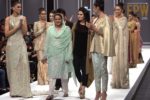
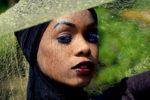
If a hijab in Pucci-designed print could speak, what would it say?
I attended a seminar presented by Professor Reina Lewis on Muslim women’s lifestyle magazines last night and was faced with this bizarre question. It all started with the actual seminar itself, which showcased the latest research adventures of the fashion and design professor. Weaving together previous work that included alternative Orientalist narratives in the 19th century and queer lifestyle magazines, Lewis’ paper focused on the Muslim women’s magazines that emerged at a crucial time (post-9/11) when more positive representations of Muslims were needed in a Western public discourse that had none. And the so usual suspects were mentioned: emel, Sisters, Muslim Girl, Azizah, and an anomaly, Alef–being the only one that didn’t try hard to get a particularly Muslim lifestyle look.
Having the enviable position of fashion professor, Lewis was more interested in how women/the human form were presented the magazines, what Islamic fashion is really all about, and the advertising contained within the magazines than the content. For her, visual representation in print media of women who were getting more covered up than their mothers, grandmothers, and their non-Muslim peers was striking and counter-cultural.

A fashion advertisement in Istanbul, Turkey.
The same way Nylon and Harper’s Bazaar are different from each other in presentation and content, Muslim lifestyle magazines set themselves apart in these ways too, but addition to that the magazines self-define or defined by others as either “Muslim” or “Islamic”. emel, Lewis said, is a “Muslim” magazine in that it reaches out to an audience of diverse backgrounds and levels of religiosity, while Azizah is more “Islamic” because it caters to a more conservative readership. It’s hard to not find these labels contentious as they could lead to a series of polemical questions, like, is emel less Islamic than say, Azizah or can a lifestyle magazine as a guide help a reader gain a more Islamic look?
Of course the latter is a silly question, but having read fashion and lifestyle magazines myself before I’d say that there is a level of self-identification in (a few of) the models and the “I am what I buy” ethos that is much invested in brand advertising today. And so for attaining the trendy or at least up-to-date Muslimah look, one only need to look at what other people are wearing, and simply flick through magazines for reference.
During the Q & A session, someone from Saudi Arabia had asked a thought-provoking question about the real purpose of fashion in faith-based women’s magazines. It was a question that I had pondered over a long time ago when I decided on two things: to not be a follower of fashion and not to wear the hijab. The question goes something like this, “If fashion is about self-expression and to a large extent ‘being noticed’, how does Islamic dressing and the fickle world of fashion reconcile with the concept of modesty and inconspicuousness?” I remember the days when I had to wear the hijab in college and becoming the object of male attention which made me uncomfortable. Without the hijab, I found to my relief that the unwanted attention seemed to have lessened, but this had nothing to do with how much skin I was showing with or without the hijab, rather the headscarf became a marker of what good young Muslim men found attractive. This was when I learned that the hijab had more complex meanings.
This brings me back to the rhetorical Pucci headscarf and what modesty means to different Muslim women. In addition to being a symbol of devotion, modesty, and cultural identity, the hijab today has taken an extra meaning, one that fits nicely with the global consumer culture and current trends. The hijab as represented even in the most conservative Islamic women’s magazines often doubles up as a fashion accessory.
Not to sound overly fussy, but isn’t being fashionable attention-grabbing and hence immodest? I need to mention again that I am not into lifestyle magazines, fashion, and do not wear the headscarf, so I’m perhaps the least equipped person to explain whether Islamic fashion is modest or not. At the same time I think my assumptions that modesty clashes with fashion is probably unfounded, too.
What are your thoughts?
Tweet
I wear the headscarf, read hijab style blogs and the occassional magazine so my answer to your question is-no hijab and fashion are not immodest.
Although I do not consider myself a fashionista (I find the term cheesy) I think that many Muslim women in hijab concerned with fashion are less narrow than those who don’t wear it who wish to define hijab as always being about the gaze of the outside world.
In other words the hijab is about a number of things modesty, beauty, intentions, sincerity, behavior but above all things it is a women’s personal decision on how she wishes to achieve these things.
Defining what is “attention-grabbing” places too much emphasis on an obscure other or others who in many cases are a figment of the imagination. For instance, wearing all black hijab and abaya may grab attention in some circles, wearing a purple hijab will mean nothing in other places. To negotiate what meaning a garment will have is to dabble in alot of conjecture and at an extreme- a type of paranoia. And when I read hadith or the verses of “covering” I don’t see Allah explaining that we wear hijab for anyone other than him and for our own protection/privacy.
Finally, I can’t think of any Islamic resource that so narrowly defines what the hijab may look like. For those of us who combine style/fashion with our hijab we are simply interpreting a rather open field.
who cares if Muslim women use the hijab as a fashion accessory or for religious purpose? It’s up to women to decide if they wanna wear hijab and it ain’t our place to question their motives for it.
by the way, there’s nothing wrong with using hijab as a fashion accessory. Freedom of expression, man.
Assalamualaikum,
I suppose if fashion is about being noticed than yes the idea of wearing things to get noticed is discouraged in islam. But there is nothing wrong in self expression, is there? I mean as a muslimah, we are ambassadors to our religion. Being neat and tidy, looking smart and modest is part of our self expression. Alhamdulillah islam has taught us self restraint so that we will be weary of fashion.
Having magazines of islamic’fashion’ is just to cater for the muslimah as we are encouraged to look beautiful for our husbands etc thos with whom we have halal relationships with, and these magazines are also good for us in the sense that it can act as a reminder, an opportunity and at the same time makes accesibility in thie developing world which we live in whereby is mostly filled with non-muslim clothing which are making things more complicated for the muslimah to decide.
Muslim ‘fashion’ allows muslims to choose from a variety of things. It allows each and every muslimah(assuming most of these magazines are for women) is able to self express themselves but in an inconspicuous way when they go out, as each muslimah is unique, at the same time remain modest.
This is just my point of view on the matter.
At the same time, I disagree on the depiction of muslim women in the magazines and posters. For an ideal magazine I have found so far, that does provide muslim ‘fashion’ and styling tips would be the SISTERS magazine. That magazine masha-Allah is very good. No pictures or usage of models. But it does indeed cater for the mulim women’s needs.
Forgive me. But I hope at least this would give some light on the matter. Insya-Allah. And do correct me if I’m wrong so I can search and learn what is truly right.
I don’t think it matters that Muslim women are being fashionable as they cover their body. I think they can be perfectly modest even if they wear something that is fashionable. If we started to believe that fashion cannot be modest, then we’d have to bring the argument all the way to colour and rule that colour is not acceptable on a Muslim woman either. This is part of fashion. So is the cut of a garment… For example, wearing straight sleeves or ones that go out at the wrists. Everything gives a certain amount of style or fashion.
I don’t follow fashion trends, but I like to look put together and I like to coordinate. And whether I want to or not, I buy my clothes in stores that are basing their collections on fashion, so I end up with styles that can be kind of “in” sometimes.
I would say though that there is such a thing as going overboard, but any person who wears loose, opaque and long clothing that covers everything but the face and hands is doing OK at the very least!
I agree that nowadays, the higab carries a lot of connotations of respectability and what “works” for an archetypcal Muslim wife, in fact it is the status quo. When it comes to visibility/invisibility, or how much is revealed or not revealed when you wear the hijab, whether through expectations or anything else, should be seprate from fashion, and what it brings to light. In other words, following fashion wouldn’t disclaim modesty, much less define the role of those who don the hijab, or else fashion would in itself be the status quo we are so much trying to escape.
I guess what I’m trying to say, and that Samira asserted that clothing shouldnt speak up for hijab, but that hijab is an array of good behavior.
Samira took the words out of mouth. Not much else I can say…
Although I’m not Muslim, I have also asked whether the hijab has become a fashion accessory. When it’s fashionable does it take away from it’s spiritual importance? On the one hand, it does seem to defeat the purpose of modesty when it’s fashionable. But on the other, I would say that yes it’s possible to be fashionable and be modest at the same time.
Not to offend anyone since I am not Muslim, but the idea does seem a bit contradictory. As stated, if Muslim hijabs and attire are meant to be modest than combining them with fashion is doing the opposite of the original meaning. Of course, part of the reason could be to target American audiences as well to show that Muslims are “okay” and not so different from us after all. In a way, it could be trying to help Americans understand the lifestyle of Muslim women, while revealing it in a relatable westernized-way. Although this is somewhat demeaning and not truly showing the culture, it could be a possibility—along with the possibility that the consumer industry is doing nothing more than targeting Muslim women now too. Then again, Muslim attire has always leaned towards more individualism with the various types of cloth dressings that could be taken as defining a Muslim woman’s fashion–this includes silk being a more valued cloth and cotton being a lesser valued material. The designing of fashionable hijabs just might be an expanded version of this cloth-valued concept.
In the end, it is up to the individual Muslim woman if she wants a plain or decorated hijab. Perhaps she wears it out of modesty, maybe to grab attention, or another reason entirely. To say that it is a betrayal to religion is a little extreme, especially if you look at all the Christian paraphernalia that is on the market. Muslim women shouldn’t be condemned for their choice in headwear even with the argument that it has religious ties. Christmas is supposed to have religious ties but for the most part it has become a consumer holiday, and Jesus has been replaced with Santa Claus yet no one has really made a huge deal over it. Every religion is going to have questionable departures from the original traditions, but the individual must be the one to decide what is right for him/her.
Samira,
Thanks for your comment. Perhaps I understand the meaning of “attention-grabbing” from a specific and personal point of view, and perhaps something I’ve been ingrained with from my madrasa days!
I used to write the motoring section for emel with Fazeel Ashraf. I had a great time doing it and highly recommend the magazine although I have not read it in awhile. I remember the models in the style section had their photos cut off at the neck to hide their faces. I thought the editor was going overboard. It’s a personal choice what people wear but imo modesty does not have to mean hiding, just not flaunting.
I’m reminded of a flyer posted by one of the clubs at school a few months ago. It showed a sitting girl from the back, progressing in five stages from tank top and ponytail to full, wrist-length head covering. Someone in my building (probably a bored student) had penciled in percentages of ‘completion’. The fashionable mid-length scarf favored by most secular subject teachers was only at 75%.
A joke? Or…?
“Of course, part of the reason could be to target American audiences as well to show that Muslims are “okay” and not so different from us after all. In a way, it could be trying to help Americans understand the lifestyle of Muslim women, while revealing it in a relatable westernized-way.”
DanyD, but then you are operating off the assumption that Muslim women are automatically “Eastern” or “from somewhere else.” There are plenty of Muslim women who are American (not immigrants) and/or from the West. Has anyone considered that we are blending our religious dress requirements with our cultural dress as many Muslim women have done around the globe?
As Samira said, “the hijab is about a number of things modesty, beauty, intentions, sincerity, behavior but above all things it is a women’s personal decision on how she wishes to achieve these things.”
Thanks Samira and Broomstick for putting what I think in a much more elaquint fashion!
yes the Hijab has many meanings, and which meanings apply depends on the lady who chooses to where it. It’s important to contextualize too. What would be considered modest in one place is different to the others. And don’t forget…even the most modest clothing have there foot in high fashion now. I recently read something about designer Abyas.
I don’t see my being modest and being inconspicuous have to go hand in hand. I think Modesty is about not displaying sexuality or overt wealth (which is least discussed) but dose have room for self expression. Form time immortal Muslim women combined modesty with color, local fashion and practicality. Look at the very wide array of traditional fashions found across the Islamic world. Why stop now?
I agree wholeheartedly that the hijab has layers of meaning (no pun intended.) It, like modesty, can translate into so many different things to so many different people that any essentialized interpretation becomes pointless and silly.
That being said, all clothing has equally ambiguous meanings. And I wonder if the same women that reject the essentialism of the hijab are also the ones who are quick to defame the bikini, mini shirt, or other “Western” (I hate that word) fashion as immodest, sexualized, slutty, immoral, so on and so forth.
I just remember reading on this blog somebody (sorry can’t remember who) commenting on a picture of a woman in a bikini, saying that it was “disgusting” and asking that it be removed.
I don’t wear hijab and occasionally I wear a short skirt. Sometimes I feel judged for this, not least by some men and “conservative” women who feel that this reflects in some way my virginity status. But sometimes a skirt is just a skirt.
I can be fashionable in a hijab. I can be modest in a miniskirt. No?
So, um, what is modest?
Modesty is relative as well. In North America a knee length skirt is modest, whereas in Saudi or Pakistan it would be immodest. Who defines what is modest? And if modesty can change by context then Muslims can change what modesty means to them based on their context.
The Islamic context is unchangeable regardless of where you are geographically. So the definition of what modesty in dressing is within the Islamic context is not something that warrants any debate because it is clear what is acceptable and is not.
What can and should be discussed is the concept of Hijab, the rationale for it, what it entails and how a Muslim woman can attain it. Too many people unfortunately equate hijab with a head covering – but that is not what it means.
A Muslim woman in a mini-skirt may very well be modest in her attitude and actions, but she is not being modest in her dressing within the Islamic context.
Do you see the difference?
@Nina:
“Do you see the difference?”
No…I don’t. I’m not clear on what is Islamic modesty. What is this universal mandated by God, and not by man within his culture (and I purposely use “man”)?
“it is clear what is acceptable and is not.”
No it’s not that clear. Modesty is socially constructed.
And what is an “Islamic context”? Who decides what is an Islamic context and what is not? From my understanding the Qur’an says to be modest, but it does not go into any detail as to what modesty looks like. The rules of modesty are imposed by culture and context.
And if the Islamic context is unchangeable then should we not be living like they did 1500 years ago?
I’m sorry, I just don’t see Islam as that rigid.
@Rochelle:
“I can be fashionable in a hijab. I can be modest in a miniskirt. No?”
I think so. It’s all about context and what your context/culture has defined as/determined to be modest.
@ Nina
First of all, you must define the term “Islamic context”. What is this “Islamic context” you are referring to? Secondly, who says this “Islamic context” doesn’t warrant any debate. And NO it isn’t clear because there is also plenty of debate on modesty and differing views/interpretations on it whether you like or not. Thirdly, who are you to tell us what can and should be discussed?
Wearing clothing or indulging in behavior and attitude that sexualizes a woman OR causes someone else to regard her in a sexual manner is immodest in the Islamic context regardless of her geographical location.
Hijab is not simply about slapping on a headscarf; it is an all-encompassing state of mind where the main intent is on protecting one’s sexuality and not displaying it overtly. That’s the larger principle that’s lacking in your understanding of Islamic context of modesty.
The whole point of wearing a mini-skirt (and showing off one’s legs) is to exude feminine sexuality and desirability. Furthermore, one cannot control the (potential) sexual thoughts of someone else who encounters you in a mini-skirt. So a Muslim female believer cannot wear a mini-skirt and be considered modest in the “Islamic” context.
And yeah, there IS a very clear Islamic context of what is acceptable attire and what is not based on the larger Islamic principle of hijab that I referred to above. It is culture that translates that context into the different forms of Islamically acceptable attire we see from the abaya to the baju kurung to the kaftan to the shalwar kameez. And the mini-skirt is not one of them.
@ Nina
Excuse me but when I wore the hijab I felt the same constant reference to my sexuality from men I encountered. These men still regarded me in a sexual manner. Men still tried to pick me up, or undress me with their leering eyes and some with even sexually harass me. These men still had sexual thoughts when I was in a hijab. Nor I am responsible for his sexual thoughts whether I’m wearing a hijab or I’m not. But instead of focusing on his modesty such as his thoughts and perception of women, you focused on her.
Even at the mosque, the topics and lectures usually addressed concerning women are restricted to the female body, what clothing is modest, what women should wear, the hijab, their voices, their very presence, the obsession with their bodies. That is also behaviour and attitudes that sexualizes me because it reduces me to my female body. (That some describe women as fitna, that their born temptresses, that their distraction to men that they shouldn’t even be in a Mosque). References limited to my body make me feel like a sexual object, makes me feel like I’m viewed as temptress.
@Nina:
“Wearing clothing or indulging in behavior and attitude that sexualizes a woman OR causes someone else to regard her in a sexual manner is immodest in the Islamic context regardless of her geographical location.”
Who defines what will sexualize a woman? In Pakistan a woman wearing capris could be sexualized, but in Canada most would not assume a woman in capris to be sexualized. Again, it comes down to context and social constructions of sexual explicitness and modesty.
“it is an all-encompassing state of mind where the main intent is on protecting one’s sexuality and not displaying it overtly. That’s the larger principle that’s lacking in your understanding of Islamic context of modesty.”
Again, what does it mean to display sexuality overtly? vs covertly? Who decides this?
“The whole point of wearing a mini-skirt (and showing off one’s legs) is to exude feminine sexuality and desirability.”
Who says a woman wears a short skirt to show off one’s legs? I’ve worn short skirts because I like the way they look or because it’s hot out, not because I want to show off my legs. You’re making a huge leap by assuming you know the intentions of a wearer.
“Furthermore, one cannot control the (potential) sexual thoughts of someone else who encounters you in a mini-skirt.”
One cannot control the potential sexual thoughts of others EVER regardless of what they wear or do. Those are someone else’s thoughts. We as women cannot control the thoughts of the people we come across. It’s impossible.
“And the mini-skirt is not one of them.”
Says who? Why not? What is it about the short skirt that cannot make it modest if the society in which I live says it’s modest? Even if I personally feel it is not modest I cannot deny that the society I live in deems it modest.
Muslims no longer live only in Muslim majority countries and definitions and realities of what it means to be a Muslim are changing as a result, as they should.
“The whole point of wearing a mini-skirt (and showing off one’s legs) is to exude feminine sexuality and desirability.”
Sometimes a skirt is just a skirt.
You, like some men, assume that if I show skin it is because I want to put my sexuality on display and that I am open to sexual provocation. “She was asking for it”. No. Sometimes I wear shorts because I’m damn hot — not because I want everyone to see my awkward, hairy legs.
This is the problem with societies that impose a strict dress code. Where I come from, girls dress in a wide range of attire and men at a young age must learn how to filter their words and behaviors regardless of what is “provoking” them. This is called respect. However, when I was in Iran for instance, I felt that some men lacked this filter, and (regardless of what I wearing — I was dressed quite conservatively if I do say so myself) felt it was within their rights to sexualize me and express whatever thought or desire that popped into their puny unholy little brains.
It is not your place to assume to know what my motives are for wearing the things that I do. It is your job (and everyone elses) to treat me with the same respect and consideration as you would anyone else.
“The whole point of wearing a mini-skirt (and showing off one’s legs) is to exude feminine sexuality and desirability.”
That’s quite an assumption to make. And like the others have pointed out, who says that when a woman wears a mini skirt it’s for the reason you said? It’s not. Besides, in some way that’s like me assuming you’re wearing your hijab because you’re forced to and being oppressed by it.
I’ve worn mini skirts before, but I never did so to show feminine sexuality nor desirability. I wore it because I wanted to, had nothing to do with “showing off” my sexuality or flaunting it.
But
There are places on this world where wearing any skirt that doesn’t go all the way to the ankles is horrifyingly immodest, while it’s quite appropriate to not cover the upper body and breasts at all. There are other places where you can wear a miniskirt without being considered immodest, but you must always have your breasts covered. Thus, modesty is depending on place (and time). And it can never be a woman’s job to make sure men don’t have sexual thoughts about her; as others have already said, there is nothing you can wear that will erase those thoughts.
[...] Muslimah Media Watch: Marketing Muslim Lifestyles and Rethinking Modesty [...]
Does this site practice censorship?
My response of Nov. 20 is not posted. In anycase, I have kept a copy of what I wrote on a different computer, and I plan to re-post it later to see if it goes through.
The few responses here demonstrate the bridge between the Islamic conception of mdoesty vs. the non-Islamic conception of modesty. The latter had once fit with the Islamic conception, but it has transformed to the form it is today (i.e.: you can cover or uncover your breasts depending on the place and time”).
[Editor's Note: Nina, we DO have a comment moderation policy, and I felt your comments violated the "respectful of other's views" clause, and so I did not publish them.]
@ Nina:
Not to harp on this again, but what exactly is Islamic modesty and who defines it? As far as I remember there is no fashion section of the Qur’an. And if it’s not in the Qur’an then we could conceivably say that it’s context specific.